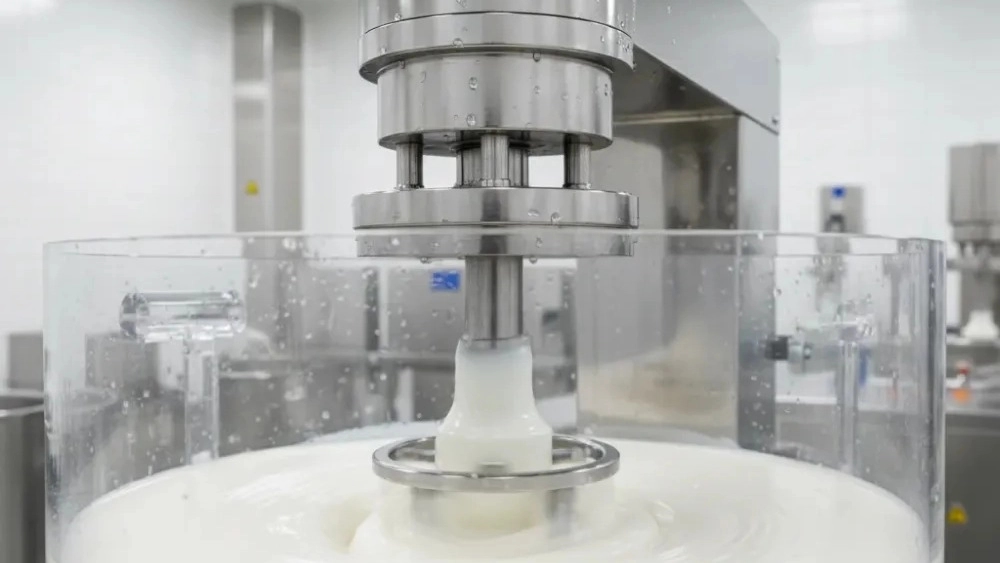
What is a homogenizer mixer?
- Shear
- High pressure
- High rotation speed
Applications of mixer homogenizer in different industries
1. Food industry
- Sauces (mayonnaise, ketchup, salad dressing)
- Dairy products (milk, cream, yogurt, dairy drinks)
- Jam, fruit puree, liquid chocolate
- Concentrated drinks and concentrates
2. Pharmaceutical and chemical industries
- Medicated creams and ointments
- Syrups and suspensions
- Chemical and laboratory solutions
3. Cosmetics industry
- Cream and lotion
- Cosmetic gels
- Shampoo and conditioners
4. Advanced polymer and chemical industries
- Paints and resins
- Adhesives
- Polymer compounds
Types of homogenizer mixers
1. Rotor-stator homogenizer
- Suitable for medium volumes
- Optimized energy consumption
- Can be installed on the tank
2. High pressure homogenizer
- Very high accuracy
- Suitable for sensitive pharmaceutical and food industries
- Higher price than normal models
3. Linear homogenizer mixer (Inline)
- Installation in the production line
- Suitable for continuous production
- Increasing the speed of the production process
4. Laboratory homogenizer
- Special for testing and research
- Small dimensions
- Suitable for R&D centers
Advantages of using a homogenizer mixer
✅ Increasing the quality and uniformity of the product
✅ Reduction of production time
✅ Improve product shelf life
✅ Better control of particle size
✅ Reduce the waste of raw materials
✅ Increasing the efficiency of the production line
The main components of the homogenizer mixer
- Powerful electric motor
- Agitator shaft and blades
- Rotor and stator
- Speed control system
- Stainless steel body (in industrial and sanitary models)
Important points in choosing the right homogenizer mixer
For the correct choice, the following points should be considered:
- Required production capacity
- Material type (liquid, semi-solid, viscous)
- Product sensitivity to temperature and pressure
- Used industry (food, pharmaceutical, chemical)
- Washability and CIP
- Motor power and speed
The difference between a normal mixer and a homogenizer mixer
While conventional mixers only do the initial mixing, the homogenizer mixer crushes the particles down to the micron level and creates a stable and uniform mixture. For this reason, it is necessary to use a homogenizer in sensitive processes.
The role of the homogenizer mixer in increasing the quality of the final product
Using a homogenizer mixer causes:
- Improving the appearance of the product
- Preventing biphasing
- Increasing consumer satisfaction
- Consolidating quality over time
It is possible that this matter has a direct role in the success of the brand.
summary
The homogenizer mixer is considered one of the vital equipments in various industries, without which it is difficult to obtain a uniform and high-quality product. Choosing the right device according to the needs of the production line can increase productivity and reduce production costs significantly.